
Decision Guide
Should I Restore or Replace an Original Wood-Shingle Roof on a North Slope or Stadium District Home?
How to decide between restoring and replacing an original wood-shingle roof on a pre-1930 Tacoma historic-district home, and what the district's material guidance actually allows.
Restoration is realistic only when the original wood shingle and deck are still structurally sound underneath surface weathering — genuine candidates are increasingly rare on roofs approaching a century old. Most North Slope and Stadium-Seminary homes with deteriorated wood shingle are better served by replacing with composition shingle, which the Landmarks Preservation Commission identifies as the typical historic material.
Published 2026-08-31 · Updated 2026-08-31
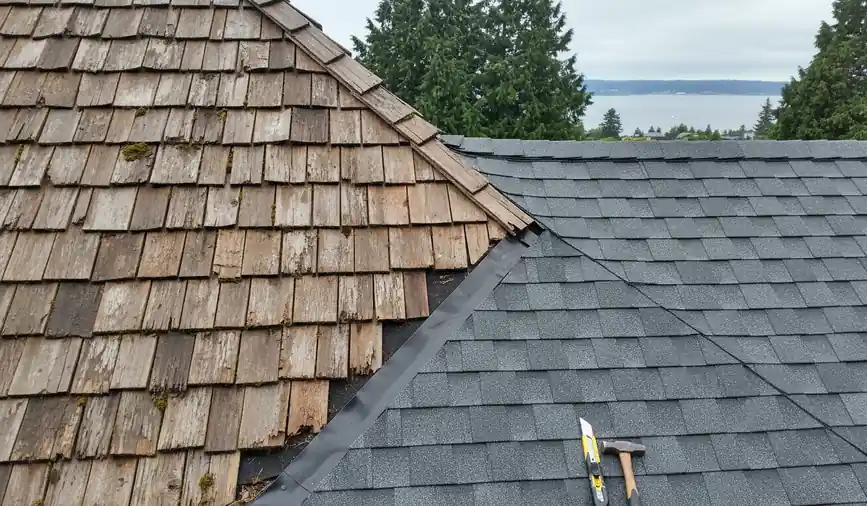
Original wood-shingle roofs are a real, if increasingly rare, feature on Tacoma’s oldest homes — and the decision to restore or replace one is more about deck condition than sentiment.
Why this question comes up specifically in North Slope and Stadium-Seminary
Roughly 80% of North Slope’s homes were built before 1930, across three construction booms (1888-93, 1902-15, 1919-29), and Stadium-Seminary has been on the National Register since 1977 with roughly 400 buildings on the bluff above Commencement Bay. Homes from these eras were commonly originally roofed in wood shingle, and some retain remnants of that original material — or a later replacement roof that’s now itself decades old.
What genuine restoration actually requires
Restoring an original wood-shingle roof isn’t a cleaning or a coating — it means the existing shingles and, critically, the deck underneath are still structurally sound enough to work with. On a roof approaching or past a century old, that’s an increasingly high bar: wood shingle has a shorter practical service life than modern materials even when well-maintained, and the deck beneath it has usually been exposed to a century of Tacoma’s roughly 39-43 inches of annual rain. Genuine restoration candidates exist, but they’re the exception rather than the rule at this point in most of these roofs’ service lives.
Why replacement is usually the realistic answer
When the original wood shingle has deteriorated past a sound restoration point — cupping, splitting, moss infiltration, or visible deck moisture — replacement is generally the more practical and cost-effective path. The Landmarks Preservation Commission’s own published guidance identifies composition shingle as the typical historic material for these districts, meaning a composition-shingle replacement isn’t a departure from historic character — it’s the documented standard the review process itself points to. Standing-seam metal is also acceptable on simple roof structures, giving a second legitimate option depending on the home’s specific roofline.
What to check before deciding
- Deck condition underneath the existing shingles — soft spots, delamination, or visible rot generally settle the question in favor of replacement, since restoration can’t fix what’s happening below the surface material.
- Extent of shingle deterioration — scattered wear across a still-intact shingle field reads differently than widespread cupping, splitting, or moss-driven lifting.
- Whether the project triggers a permit — a straightforward replacement with no roofline change is typically permit-exempt under Tacoma’s rules, which also means it’s exempt from Landmarks Preservation Commission review; a roofline change or layering brings both in.
The century-home wrinkle: what’s often found underneath
Pulling back original wood shingle on a home this age frequently reveals deck problems that weren’t visible from the surface — see our guide on common roof-deck problems in Tacoma’s century-old homes for what that typically looks like and how it factors into the restore-vs-replace decision once the roof is actually opened up.
Bottom line
Restoration is real but rare at this point in most original wood-shingle roofs’ lives; replacement with composition shingle — the district’s own documented standard material — is the realistic path for most North Slope and Stadium-Seminary homes. Call (253) 201-1336 and we’ll assess your specific roof’s deck and shingle condition before recommending either.
The bottom line
If you want this priced for your own roof rather than in ranges, we come out and inspect at no charge across Tacoma and Pierce County. You get a written per-square price with tear-off and any deck repair broken out separately. Call (253) 201-1336.