Learn
What Roof Maintenance Program Reduces Leak Calls for Warehouse and Logistics Buildings Near the Port of Tacoma?
A planned commercial roof maintenance approach for warehouse and logistics buildings in Tacoma's Port and Fife industrial corridor, and why reactive repair costs more over time.
A planned maintenance program — scheduled inspections twice a year plus after major storms, prompt repair of small membrane and seam issues, and drainage checks — reduces leak calls by catching problems before they become active leaks that disrupt an occupied facility. This matters most for warehouse and logistics buildings near the Port of Tacoma corridor.
Published 2026-08-31 · Updated 2026-08-31
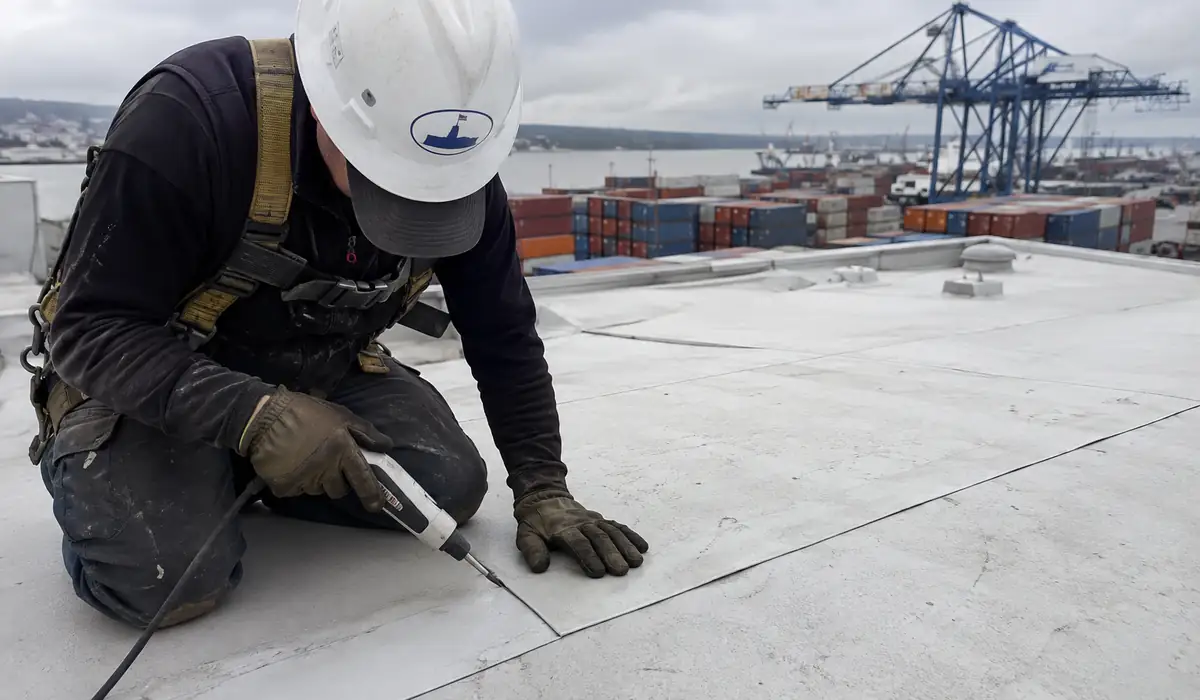
Tacoma’s industrial corridor is real and active — and the roofs over it benefit from a different maintenance posture than a typical retail or office building.
Why this corridor is a genuine commercial roofing market
The Port of Tacoma, established by Pierce County voters in 1918 starting on 240 acres and now covering 2,400+ acres, is the 6th-busiest container port in North America and among the 25 busiest in the world as of 2025. The adjacent Fife/Puyallup Tribe logistics corridor is actively expanding — a 90,000 square foot tribal warehouse already operating, a 140,000 square foot manufacturing center under construction, and 300+ acres of tribal commercial and industrial land across Tacoma’s industrial core. This is a genuinely active, growing base of large warehouse and logistics roof square footage, not a generic “we also do commercial” claim.
Why reactive repair costs more here than the repair bill suggests
On an occupied warehouse or logistics building, an active roof leak doesn’t just cost the repair itself — it risks stored inventory, disrupts operations, and can require sections of the facility to be cleared or covered while repairs happen. A maintenance program’s entire value proposition is catching the small, cheap-to-fix problem (a seam starting to separate, a membrane puncture from foot traffic) before it becomes the expensive, disruptive one (an active leak over product or equipment).
What a planned maintenance visit actually covers
- Membrane condition — checking for punctures, blistering, or brittleness across the full roof surface, not just areas with known history.
- Seam integrity — the most common failure point on single-ply membrane systems, worth checking specifically rather than assuming a visually intact roof has sound seams throughout.
- Drainage performance — confirming water is actually reaching and draining through interior drains or scuppers, since ponding water sitting for extended periods accelerates membrane wear.
- Flashing and penetrations — rooftop HVAC units, vents, and equipment mounts are common leak-origin points on warehouse roofs with significant rooftop equipment.
- Post-storm checks — an additional inspection after major windstorms catches wind-lifted membrane or debris damage before the next rain event turns it into an active leak.
How this fits a facility that can’t easily go offline
Scheduled maintenance visits can typically be planned around a facility’s operating schedule rather than requiring a disruptive emergency call, which is one of the practical advantages of a planned program over a reactive one for an active logistics or warehouse operation.
Bottom line
A twice-a-year inspection schedule plus post-storm checks catches small commercial roof problems before they become disruptive leak events — a real cost and operations advantage for warehouse and logistics buildings in Tacoma’s Port and Fife industrial corridor. Call (253) 201-1336 to set up a maintenance program for your facility.
The bottom line
If you want this priced for your own roof rather than in ranges, we come out and inspect at no charge across Tacoma and Pierce County. You get a written per-square price with tear-off and any deck repair broken out separately. Call (253) 201-1336.