
Decision Guide
TPO vs. EPDM vs. Modified Bitumen — Which Is Right for a Tacoma Commercial Building?
How TPO, EPDM, and modified bitumen compare for a flat or low-slope commercial roof in Tacoma — seaming method, durability, and where each fits best.
TPO is a heat-welded single-ply membrane favored for reflective white surfaces and strong seam strength; EPDM is a rubber single-ply membrane with a long track record and simpler patch repairs; modified bitumen is a multi-layer, torch-or-adhesive-applied system with strong puncture resistance, often chosen for roofs with heavier foot traffic or equipment. The right one depends on your building's roof access, insulation needs, and maintenance approach.
Published 2026-08-31 · Updated 2026-08-31
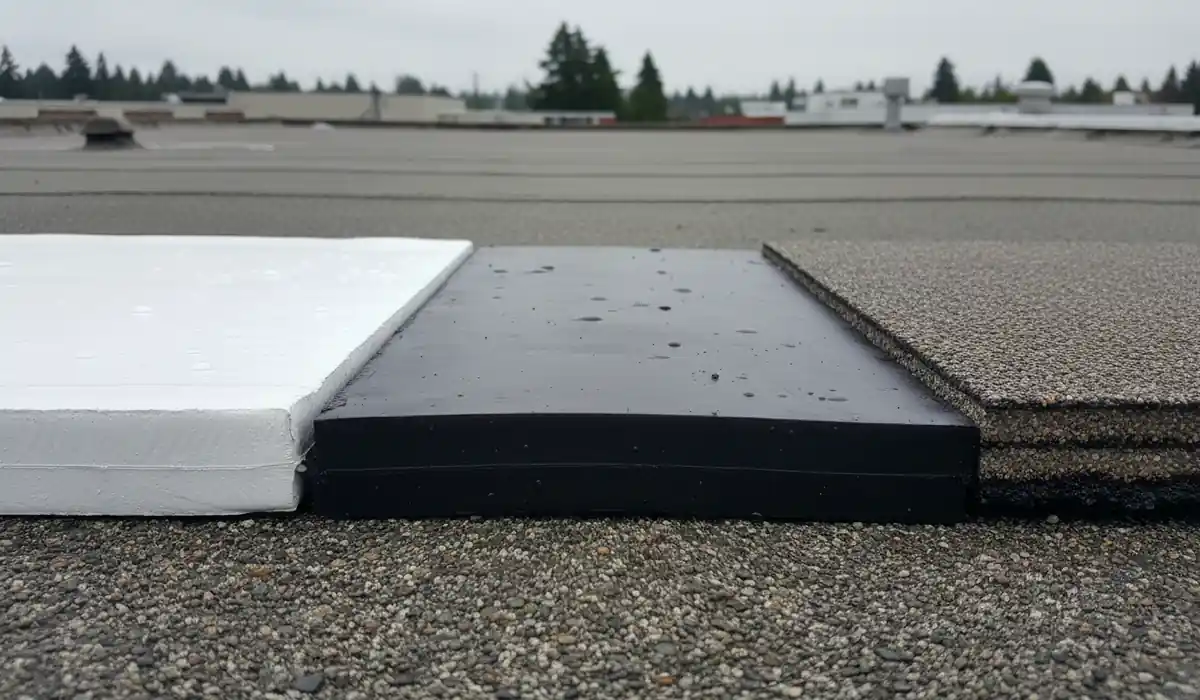
All three systems show up on Tacoma commercial and industrial roofs, and each has a genuine case for being the right choice depending on the building. Here’s how they actually compare.
TPO (thermoplastic polyolefin)
A single-ply membrane installed in wide sheets and joined with heat-welded seams, which create a strong, continuous bond rather than relying on adhesive alone. TPO is typically installed with a reflective white (or light-colored) surface, which reduces surface heat absorption. It’s become a widely specified system on new commercial low-slope installs, in part because heat-welded seams hold up well over time and the material handles UV exposure without the surface degradation older single-ply systems sometimes showed.
EPDM (ethylene propylene diene monomer)
A synthetic rubber single-ply membrane with one of the longest track records of any flat-roof system, typically installed in black (though white EPDM exists). Seams are joined with adhesive or tape rather than heat-welding. EPDM’s biggest practical advantage is repair simplicity — patching a punctured or damaged section is generally the most straightforward of the three systems, which matters for buildings where minimizing maintenance downtime is a priority.
Modified bitumen
A multi-layer system — asphalt-based membrane reinforced with fiberglass or polyester, applied via torch, hot asphalt (mopped), cold adhesive, or self-adhering sheets. It’s generally the most puncture- and impact-resistant of the three, which makes it a common choice for roofs with heavier foot traffic, rooftop equipment servicing, or areas prone to debris impact. It’s also frequently used as a base or flashing layer even on roofs where another membrane is the primary surface.
How building type and use should drive the choice
- Large, simple, low-traffic roofs (many warehouse and logistics buildings, including facilities in the Port of Tacoma/Fife industrial corridor) — TPO’s heat-welded seams and reflective surface are a strong general-purpose fit.
- Roofs where fast, simple future repairs matter most — EPDM’s straightforward patching is a real practical advantage over the roof’s life.
- Roofs with heavy foot traffic, rooftop equipment, or impact exposure — modified bitumen’s puncture resistance holds up better under repeated mechanical stress.
Insulation and drainage still matter more than membrane choice alone
Whichever membrane you choose, the insulation package underneath and the roof’s drainage design do as much to determine long-term performance as the surface material does. A well-specified EPDM roof with correct drainage will outperform a poorly detailed TPO roof with ponding-water issues — the membrane isn’t the whole story.
Bottom line
TPO, EPDM, and modified bitumen are all legitimate, commonly-installed systems — the right one depends on your building’s traffic, equipment, and maintenance priorities, not a single “best” answer. Call (253) 201-1336 and we’ll walk your specific roof and recommend the system that actually fits it.
The bottom line
If you want this priced for your own roof rather than in ranges, we come out and inspect at no charge across Tacoma and Pierce County. You get a written per-square price with tear-off and any deck repair broken out separately. Call (253) 201-1336.