
Learn
Does Homeowners Insurance Cover Wind Damage to a Roof in Washington?
How wind damage roof claims typically work under Washington homeowners policies, what usually is and isn't covered, and how to document damage correctly.
Most standard Washington homeowners policies cover roof damage caused by a sudden windstorm — missing shingles, a punctured section from wind-blown debris, or damage from a fallen limb — as a covered peril. What they typically don't cover is gradual wear, age-related deterioration, or moss/algae damage that built up over time, since insurance covers sudden events, not maintenance issues.
Published 2026-08-31 · Updated 2026-08-31
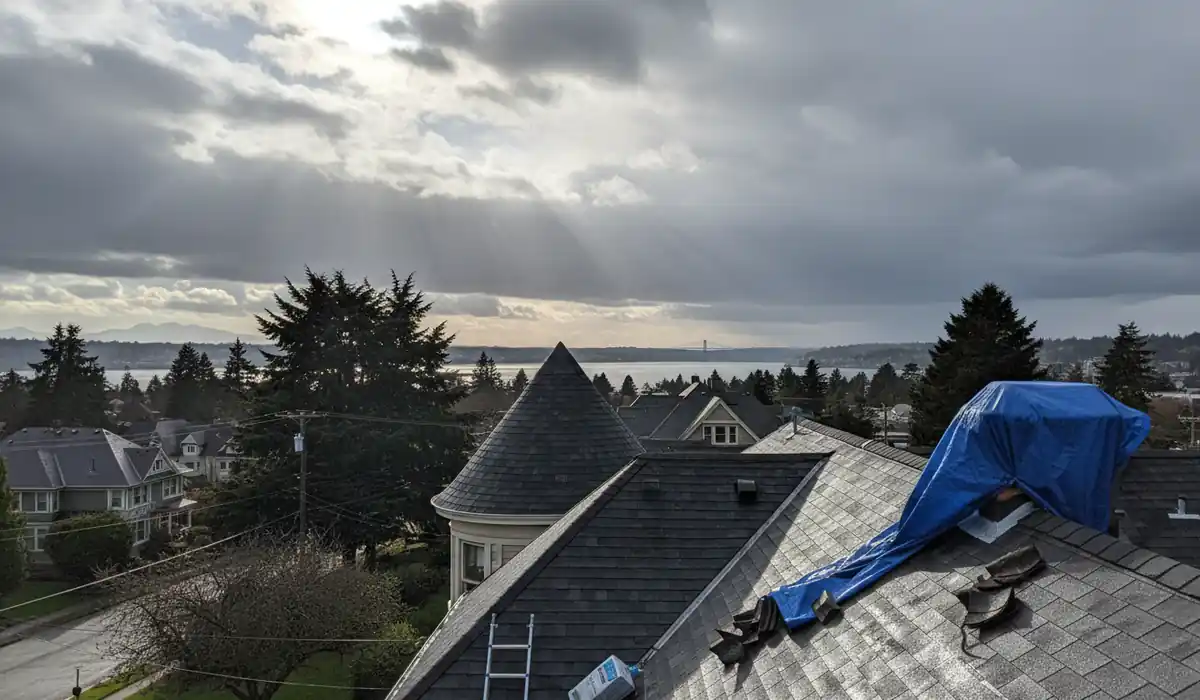
Wind damage is one of the more commonly covered roof perils under a standard homeowners policy — but “wind damage” and “wear” get confused constantly, and that distinction is what determines whether a claim gets paid.
What’s typically covered
A standard Washington homeowners policy generally treats windstorm damage as a covered peril: shingles physically torn off or lifted during a specific storm event, a section punctured or crushed by wind-blown debris or a falling tree limb, and structural damage from a tree coming down on the roof during high winds. These are sudden, identifiable events tied to a specific date — which is exactly what makes them easier to document and claim.
What’s typically not covered
Gradual deterioration isn’t a covered peril under almost any standard policy — a roof that’s simply reached the end of its rated life, granule loss from years of sun and weather exposure, or moss and algae damage that accumulated over months or years reads to an insurer as a maintenance issue, not an insurable loss. This is true even if the visible symptom (a leak, missing granules) shows up right after a windy week — the insurer is looking at the underlying cause, not the timing.
Why Tacoma sees real wind exposure
Tacoma sits directly on open Puget Sound water at Commencement Bay, with the Tacoma Narrows channel running past the city — the same channel whose winds famously tore apart the original Tacoma Narrows Bridge in 1940. That kind of direct water exposure means windstorm season (roughly November through February) produces real, recurring wind events here, not a rare occurrence. That’s a genuine reason to carry wind-rated underlayment and proper fastening on any roof in this area, separate from the insurance question.
The documentation that makes or breaks a claim
The strength of a wind-damage claim usually comes down to how well it’s documented at the time — photos of the damage, ideally dated, and a clear connection to a specific storm event (weather service records, a specific date) rather than a vague “I noticed it recently.” Our guide on what to photograph before an adjuster visit walks through exactly what to capture and how.
What to do if a claim gets denied
A denial isn’t always final — ask the carrier for the specific reason in writing, and if the dispute is over cause (wind vs. wear), an independent roof inspection with photo documentation can support an appeal. This is exactly the kind of situation our guide on storm damage vs. pre-existing wear is built to help you sort out before you’re arguing with an adjuster.
Bottom line
Sudden wind damage is generally covered; gradual wear generally isn’t, and the difference matters more than almost anything else in a roofing insurance claim. If a windstorm just hit your roof, call (253) 201-1336 — we’ll document the damage the way an adjuster needs to see it and give you a written assessment you can bring to your claim.
The bottom line
If you want this priced for your own roof rather than in ranges, we come out and inspect at no charge across Tacoma and Pierce County. You get a written per-square price with tear-off and any deck repair broken out separately. Call (253) 201-1336.