
Learn
What Should I Photograph Before an Insurance Adjuster Visits My Roof?
The specific photos and documentation that support a wind or storm damage roof insurance claim in Washington, taken before the adjuster arrives.
Photograph the damage itself close-up and from a distance, the whole roof plane it's on for context, any debris that caused it (a fallen limb, storm debris), interior water intrusion if present, and the date-stamped weather event if possible. Take photos as soon as it's safe, before any cleanup or repair — documentation taken after the fact is far weaker than same-day photos.
Published 2026-08-31 · Updated 2026-08-31
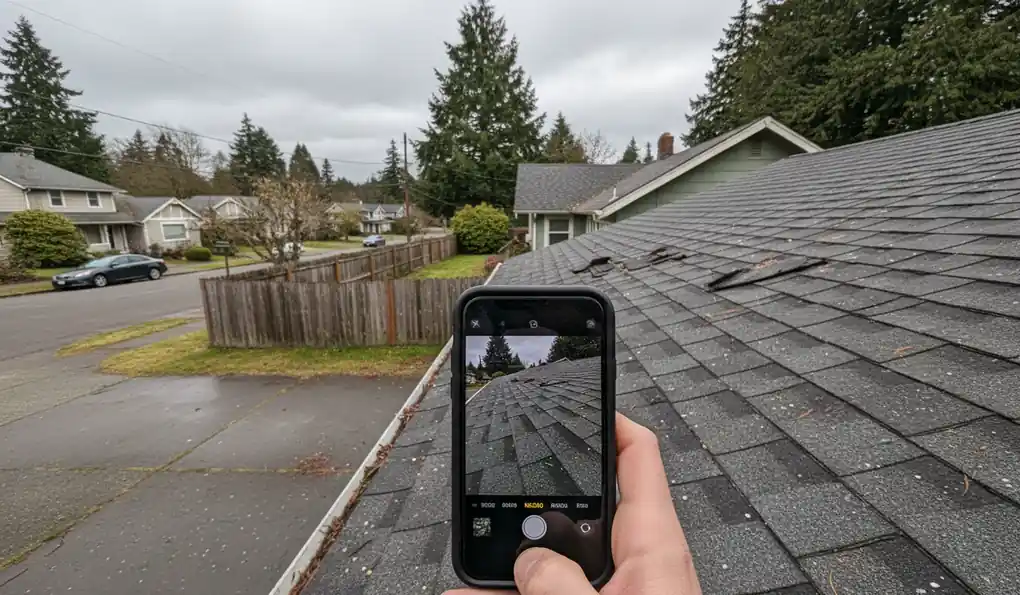
An insurance adjuster’s decision on a wind-damage claim leans heavily on documentation — and the strongest documentation is taken before the adjuster ever arrives, while the damage is fresh. Here’s exactly what to capture.
Photograph the damage itself, two ways
Take close-up shots of the specific damage — missing or torn shingles, a puncture, cracked flashing — close enough to show detail clearly. Then step back and photograph the same area from a distance, showing where it sits on the roof plane. Adjusters need both: the close-up proves what happened, the wide shot proves where and how much.
Photograph the whole roof, not just the damaged section
Even if damage is concentrated in one area, photograph every roof plane and elevation. This establishes a baseline for the rest of the roof’s condition and heads off a common denial reason — a carrier arguing that damage found in one spot is evidence of broader pre-existing wear rather than a discrete storm event.
Photograph the cause, if it’s visible
A fallen tree limb, storm debris on the roof or in the yard, or a downed branch near the damaged section directly supports a wind-caused claim. If the cause is visible and connects logically to the damage location, photograph it before it’s cleared away.
Photograph interior damage, if there is any
Water stains on a ceiling, ceiling sag, or visible daylight through the attic all support a roof-source water intrusion claim. Interior damage timestamped close to the storm date strengthens the connection between the weather event and the loss.
Note the date and weather event specifically
Write down or photograph a weather report, local news coverage, or any dated record of the specific storm — wind speed, date, and time if available. Insurers often cross-reference claims against recorded weather events for the claimed date and location, so having your own record of which storm caused the damage supports your timeline.
Keep a written log alongside the photos
A simple dated note — when you first noticed the damage, when the storm occurred, any temporary repairs made (tarping, for example) — adds context photos alone don’t capture, and shows you acted promptly rather than letting damage sit.
Bottom line
Good documentation taken immediately after a storm is the single biggest factor in how smoothly a wind-damage roof claim goes. If a windstorm just hit your roof, call (253) 201-1336 — we’ll do a same-day damage assessment with photo documentation you can hand directly to your adjuster.
The bottom line
If you want this priced for your own roof rather than in ranges, we come out and inspect at no charge across Tacoma and Pierce County. You get a written per-square price with tear-off and any deck repair broken out separately. Call (253) 201-1336.